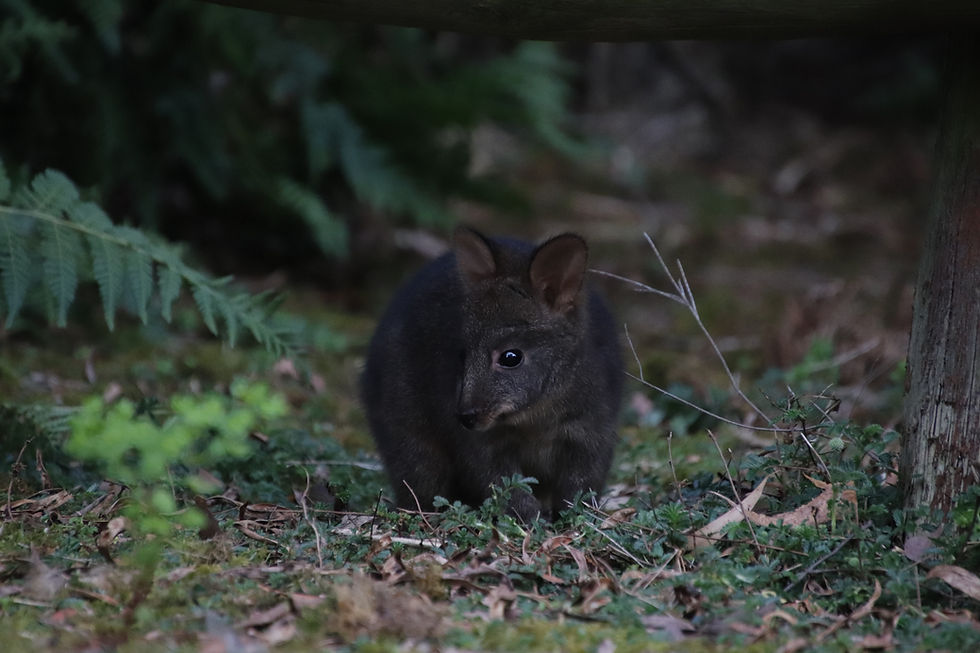
Possums!
Look, it’s likely if you live anywhere in Australia, you may have seen a possum before. They are a widespread marsupial that occur in every state. Twenty seven species make up the common definition of a possum- they can dwell in rainforest, eucalypt forest, woodland, heath and even urban areas, and are primarily defined by three features:
-Their ability to climb
-Having a single pair of front lower incisors
-The second and third toes on the hind foot are totally fused except for the claws.

Their shapes and sizes are as diverse as their lifestyles- the smallest possum weighs seven grams and is around seven centimetres long (have a look at your little finger to picture it’s size) and the largest weighs almost five kilograms, measuring in at over half a metre long.
On the Night Walk Adventure, we regularly encounter two species of possum: the common brushtail possum, and the common ringtail possum. As the names suggest, these animals are found widespread in other states of Australia. We have, on rare occasion, also encountered the little pygmy possum- thought once to only exist in Tasmania, this tiny marsupial has also now been found in North West Victoria, South West South Australia and Kangaroo Island.
Now, despite the fact that these possum species are often seen readily by residents and travellers of Australia, that doesn’t make them less special. Personally, I could watch a brushtail possum all day. I have done, in fact. When I first came to Australia in 2020, living at a campsite outside of Hobart, I sat and watched brushtail possums for hours at a time. I got to know individuals, I recognised their own characteristics and personality traits. I watched them interact with each other- their power struggles, teamwork, affection and teaching. I was impressed by their problem solving and dexterity. Though watching a possum open the zip of a backpack to get inside isn’t exactly a natural behaviour, it was impressive to watch before the bag’s owner realised, screamed, and the possum casually walked away, leapt onto a pillar, climbed it and exited the camp kitchen inverted along a drainpipe.
When we observe a brushtail possum on the Night Walk Adventure, it’s quite a different story of course. Out here they are in their natural environment and thriving in it. They follow seasonal change, weather patterns and breed, carry their joeys and train them accordingly. We have been ‘mugged’ by a possum on many occasions- when the possum sits on the path ahead and decides not to move, leaving us unable to continue until it decides to go off into the bushes. We’ve been watched wearily from the bushes, seen possums athletically bound up a tree upon our arrival and have heard their shrieks and calls in the crisp clear air.
Encountering the more elusive common ringtail possum is always a treat as well. Kaylee and I first heard the call of a ringtail possum in Margaret River, WA whilst camping in our rooftop tent. We wondered what this tiny little laser beam like sound was before seeing a western ringtail in the shrubs outside the tent. It was that experience that had us fascinated with their sounds, which we often hear along the trail. As ringtails are a bit more shy and small, we nearly always hear their calls before seeing them. This is why part of the Night Walk Adventure includes calls of animals and how to recognise them, with examples all recorded by us in their natural habitats around Strahan. It’s always fun to have someone on the tour who is very familiar with ringtails but has never recognised their distinctive calls!
It was a different story seeing a little pygmy possum on the trail, which I can only really sum up as sheer luck. Kaylee had stopped to describe pygmy possums to our adventurers right by what we call ‘quoll corner’, which features a wonderful example of a banksia tree. It had recently flowered, so Kaylee was able to point out one for the flowers as a size comparison- ‘picture a pygmy possum wrapped around the flower’, before doing her impersonation of a pygmy possum lapping up banksia nectar (it has to be seen to be fully appreciated). Twenty minutes later, we returned in the dark and, in the red torch light, saw two tiny little eyes, on top of a tiny body wrapped around that exact flower! The first time either of us had ever seen a pygmy possum in the wild, we held back tears of joy and soon left the little pygmy possum to it’s succulent banksia. Those two little eyes seared into our memory forever!
Though possums are far flung all around Australia, and are often seen or heard by locals, we mustn’t think that they are common or in ‘plague’ proportions. Some species, such as the Western Ringtail Kaylee and I saw in WA, are vulnerable. Others are endangered, and the mountain pygmy possum is critically endangered. These incredibly important animals are fertilisers and seed spreaders benefiting a wide variety of ecosystems. They are particular and precise with their feeding and intertwine with a vast network of living things. In Tasmania, when they pass away, they become food for Tasmanian Devils, and the cycle repeats.
The beauty of their variety and distribution is that, wherever you are in Australia, you can hope to see an individual that may look and sound completely different from one of their interstate cousins. In September 2025, Kaylee and I were in the Daintree Rainforest up in North Queensland, when we were both struck by seeing a striped possum on our last night before leaving. After trying to see one for days, of course it came along unexpectedly as we were getting ready to go to bed. A memory that will stick with us, and for us a highlight of our trip.
Yes, if you hadn’t noticed based on the length and content of this post, I like possums, and it’s very easy for me to want to make sure they thrive and survive up and down and along the lengths of this country in all their whacky, impressive and wonderful incarnations.
If you’re ever in Strahan, come out on the Night Walk Adventure to learn all about them!

Josh Selby, 14/05/2026